Introduction
Samsung's J-lineup may be following the Galaxy S and A-series from a respectful distance - but is in prefect lockstep in terms of upgrades. While the flagship pair and the upper midrange A-series are understandably grabbing the global headlines, the Samsung Galaxy J7 (2016) was first announced for a number of Asian markets.
The affordable J-series are betting big on India - where the big-screened ringleader has been a popular choice. However, we found the original Samsung Galaxy J7 quite capable of making a splash in Europe too, and it didn't disappoint.
Less than a year later, the new generation is out and it looks perfectly happy with simply putting a proven formula to work.

The Galaxy J7 (2016) gets a new metal finish, a bigger battery and Marshmallow on top of a more recent, and slightly more capable, chipset. All welcome upgrades for the most prominent of the J-series but that's all Samsung could afford and stay on budget.
Just like the original, the 2016 model is offered in two versions on different markets: you can get either a Snapdragon or an Exynos chipset. The difference is negligible though, considering they both have eight Cortex-A53's.
Here go the rest of the specifications at hand.
Key features
- Dual-SIM, Dual Standby capability, microSIM
- 5.5-inch Super AMOLED touchscreen of 720p resolution and 268ppi, Gorilla Glass 4
- Exynos 7870 ; octa-core 1.6 GHz Cortex-A53; Mali-T830 GPU
- 2GB of RAM, 16GB of inbuilt storage, microSD slot (up to 128GB)
- 13MP main camera with f/1.9 lens, LED flash, 1080p@30fps video recording
- 5MP front camera with LED flash, f/2.0 lens, 1080p@30fps video recording
- Android 6.0.1 Marshmallow with TouchWiz
- LTE Cat.4, Wi-Fi 802.11 b/g/n; Bluetooth v4.0; NFC, GPS, GLONASS, microUSB 2.0 port, USB host
- 3,300mAh removable battery
- Plastic build, metal frame
Main disadvantages
- No noise canceling mic
- Only 2.4GHz Wi-Fi
- No MHL (but USB OTG is supported)
Curiously, the very first announcement of the Galaxy J7's 2016-edition revealed a 1080p screen bur we can now officially confirm that this version of the phone will only be available in China.
The rest of the specs are more or less identical between the 2015 and 2016 editions. Obviously, the quality of selfies is still an important selling point, so the Galaxy J7 (2016) packs an updated 5MP front-facer with a fast f/1.9 aperture and an LED flash.


Samsung Galaxy J7 (2016) official images

Overall, the Galaxy J7 (2016) seems like a small step forward for the J-series, but if Samsung found the right bits to tweak, we may be looking at simple and affordable package that just got better.
As usual, we get the review underway with the unboxing and hardware overview and hope to find out soon.
Samsung Galaxy J7 (2016) 360-degree spin
One issue we had with the original J7 was that it used Samsung's old design language. Now that the new aesthetic introduced by the Galaxy S6 flagships is finally becoming available to the lower ranks, the Galaxy J7 (2016) is narrower, shorter and only a tad thicker than its predecessor at 151.7 x 76 x 7.8mm. And it packs a bigger battery as well.
Interestingly enough, the larger capacity hasn't come at the expense of weight, and due to improved materials and lighter components, the new Galaxy J7 is a gram lighter than the outgoing model.
Hardware overview
Just like the Galaxy J5 (2016), the bigger J7 comes with a new design compared to its predecessor. The plastic build of old makes way to a new, more stylish metal frame. To be fair, there's still plastic to be found but the back cover sports a tastefully done brushed metal finish that works pretty well.
There's a subtle camera bump, but it's not much of an issue. The ensemble including a LED flash and a speaker grille is well designed.


Quite enjoyable design at the backThe frame is chamfered at the front and back while the sides are finished in the phone's main color. They're nearly flat, which helps a better grip.

Speaking of the sides, Samsung follows its traditional button layout. The Power/Lock is on the right, while the volume rocker is on the left.


The sides are flat for a better grip

The Galaxy J7 (2016) display has a fair bit of bezel, but nothing that gets in the way. Below the screen, Samsung's traditional home button is surrounded by a capacitive Task switcher on the left and a Back button on the right.
Above the display, there's a front-facing camera on the left with the LED flash unusually positioned on the opposite side. In the center, there's an earpiece and a proximity sensor. Sadly, like in the smaller Galaxy J5 (2016) an ambient light sensor is missing here.


Samsung offers nothing new above and below the display

At the bottom, you'll find the microUSB port, the main (and only) mic as well as the 3.5mm headphone jack. There's nothing of note at the top.


The 3300mAh battery is removable

Removing the back cover reveals the 3,300mAh battery as well as the microSIM and microSD card slots. Notice the NFC chip on the back panel, as well.
The 3300mAh battery is removable

Handling the Galaxy J5 (2016) is a pleasure. If five and a half inches of screen diagonal aren't too much for you, the metal frame and solid weight make up for a pretty nice feel in hand.

The Galaxy J7 (2016) in the hand

Display
The Galaxy J7 (2016) is equipped with a 5.5" Super AMOLED display similarly to its predecessor. As we said in the beginning, the international version has 1280x720 pixel resolution, which isn't great, but is still favored by manufacturers in the lower part of the price spectrum. Even with it, the pixel density is adequate at 267ppi.

As with most of its Super AMOLED devices, Samsung has included a number of display modes. In Basic mode, colors are most accurate, whereas AMOLED cinema, they're notably oversaturated. The middle ground is AMOLED photo.
| Display test | 100% brightness | ||
| Black, cd/m2 | White, cd/m2 | ||
| 0 | 500 | ∞ | |
| 0.00 | 353 | ∞ | |
| 0.00 | 484 | ∞ | |
| 0.42 | 403 | 953 | |
| 0.44 | 441 | 998 | |
| 0.00 | 351 | ∞ | |
| 0.52 | 459 | 883 | |
| 0.66 | 596 | 903 | |
| 0.00 | 352 | ∞ | |
| 0.44 | 473 | 1073 | |
| 0.46 | 500 | 1094 | |
| 0.17 | 306 | 1855 | |
| 0.20 | 378 | 1881 | |
As with is normal for a Super AMOLED unit, the Galaxy J7 (2016)'s screen offers great contrast. The display is decently bright at 353 nits. Tick the Outdoor mode option, and brightness is cranked up to 484 nits.
You certainly won't have problems using the Galaxy J7 (2016)'s display in sunlight. The phone's bright enough and has a 3.756 ratio, which goes up to 3.902 in outdoor mode.
Sunlight contrast ratio
- Samsung Galaxy S6 edge+
4.615 - Samsung Galaxy S7 edge
4.439 - Samsung Galaxy S7
4.376 - HTC One A9
4.274 - Samsung Galaxy A3
4.241 - Samsung Galaxy S6 edge
4.124 - Samsung Galaxy Note5
4.09 - Huawei Nexus 6P
4.019 - OnePlus X
3.983 - Oppo R7s
3.964 - Samsung Galaxy A7 (2016)
3.918 - Samsung Galaxy J7 (2016) outdoor mode
3.902 - Samsung Galaxy A5
3.895 - Samsung Galaxy J7 outdoor
3.879 - Samsung Galaxy J2 outdoor
3.873 - Samsung Galaxy A8
3.859 - Apple iPhone 6
3.838 - Samsung Galaxy A9 (2016)
3.817 - Motorola Moto X (2014)
3.816 - Samsung Galaxy A5 (2016)
3.789 - Apple iPhone 6s
3.783 - Meizu Pro 5
3.781 - Microsoft Lumia 650
3.772 - Samsung Galaxy J7 (2016)
3.756 - Oppo F1 Plus
3.709 - Vivo X5Pro
3.706 - Apple iPhone SE
3.681 - Samsung Galaxy A7
3.679 - Meizu PRO 6
3.659 - BlackBerry Priv
3.645 - Apple iPhone 6s Plus
3.53 - Acer Jade Primo
3.521 - Microsoft Lumia 950
3.512 - Oppo R7 Plus
3.499 - Samsung Galaxy J7
3.422 - Meizu MX5
3.416 - Oppo R7
3.32 - Samsung Galaxy J2
3.235 - Sony Xperia X Performance
3.234 - Motorola Moto X Play
3.222 - Huawei P9
3.195 - Lenovo Vibe Shot
3.113 - Motorola Moto X Force
3.105 - LG Nexus 5X
3.092 - Huawei Mate S
3.073 - Microsoft Lumia 640 XL
3.065 - Apple iPhone 6 Plus
3.023 - Sony Xperia X
2.989 - Samsung Galaxy Note
2.97 - Huawei Mate 8
2.949 - LG G5
2.905 - HTC One S
2.901 - Sony Xperia Z5
2.876 - Microsoft Lumia 550
2.851 - Sony Xperia Z5 compact
2.784 - LG V10
2.744 - Xiaomi Redmi 3
2.735 - Sony Xperia M5
2.69 - Vivo V3Max
2.659 - Xiaomi Mi 4i
2.641 - Xiaomi Mi 4c
2.574 - LeEco Le Max 2
2.567 - Microsoft Lumia 640
2.563 - Oppo F1
2.528 - Sony Xperia Z5 Premium
2.525 - Sony Xperia M4 Aqua
2.503 - Motorola Moto G
2.477 - Lenovo Vibe K5 Plus
2.473 - Huawei G8
2.471 - Sony Xperia Z
2.462 - Huawei Honor 7
2.406 - ZUK Z1 by Lenovo
2.382 - HTC 10
2.378 - Samsung Galaxy J5 (2016)
2.378 - HTC One E9+
2.305 - Alcatel One Touch Hero
2.272 - Lenovo Vibe K4 Note
2.254 - Sony Xperia C5 Ultra
2.253 - Xiaomi Redmi Note 3 (MediaTek)
2.249 - Sony Xperia C4 Dual
2.235 - Motorola Moto G (2014)
2.233 - LG Nexus 5
2.228 - Huawei P8
2.196 - Xiaomi Redmi Note 2
2.166 - OnePlus Two
2.165 - HTC One X
2.158 - LG Aka
2.145 - Archos 50 Diamond
2.134 - Xiaomi Redmi Note
2.119 - Acer Liquid X2
2.084 - Huawei P8lite
2.078 - Moto G 3rd gen max manual
2.026 - Xiaomi Mi Max
1.996 - Sony Xperia E4g
1.972 - OnePlus One
1.961 - Meizu m3 note
1.923 - BlackBerry Leap
1.892 - Meizu m2 note
1.892 - HTC Butterfly
1.873 - ZTE Nubia Z9 mini
1.759 - Sony Xperia U
1.758 - Asus Zenfone Selfie
1.68 - Motorola Moto E (2nd Gen)
1.675 - ZTE Nubia Z9
1.659 - Jolla Jolla
1.605 - Motorola Moto E
1.545 - Sony Xperia M
1.473 - Xiaomi Redmi 2
1.311 - Sony Xperia C
1.283 - Meizu MX
1.221 - Sony Xperia E
1.215
Samsung Galaxy J7 (2016) battery life
Inside the phone, there's a 3,300mAh Li-Ion battery, which users can replace with ease. The combination of 720p resolution and 14nm chipset manufacturing process promises solid battery life on paper, but we're not ones to go by the specsheet alone.
A few days of testing later, we were nothing short of amazed by the J7's battery life. It achieved more than 18 hours in our video playback test. When browsing the web over Wi-Fi, the result isn't quite as spectacular, but is still great at almost 12 and a half hours. On a 3G voice call the smartphone is good for a full day and change.
All that adds up to an overall endurance rating of 101 hours - an excellent result. It's a resonable 10-hour improvement on the previous generation and some 30 hours on top of direct competitors like the Xiaomi Redmi Note 3 (72h) and the Lenovo Vibe K4 Note (73h).

The battery testing procedure is described in detail in case you're interested in the nitty-gritties. You can also check out our complete battery test table, where you can see how all of the smartphones we've tested will compare under your own typical use.
Connectivity
In a predictable Samsung nature, the Galaxy J7 (2016) is available in single-SIM and dual-SIM variants, so you can get some flexibility in terms of carriers and plans.
Naturally, you get Wi-Fi, but it only operates on the 2.4GHz band, so needless to say there's no Wi-Fi ac support. There's GPS with A-GPS, Bluetooth v.4.0, and an FM radio receiver. NFC is also on board with a dedicated options menu in the Settings.
Wired options include a microUSB port and a 3.5mm jack. The microUSB port can be used to attach an external accessory as it supports USB On-The-Go.
Android 6.0.1 Marshmallow at your service
The Samsung Galaxy J7 (2016) boots up with Android 6.0.1 Marshmallow with TouchWiz UI on top. The latest available version of Android bundles cool features like native support for an app manager, Doze mode, and Google Now on Tap among other tweaks.

The homescreen is perfectly identical to the TouchWiz home of other Samsung phones in the lineup.


Homescreen • Briefing • App drawer • App drawer settings

The Notification area is pretty busy by default. It starts with a scrollable line of quick toggles on top, then a brightness slider, then the S Finder and Quick connect buttons. You can hide them from the Edit option, which also lets you re-arrange the quick toggles.

Notification area • Modifying the notification area

Don't like the default look of TouchWiz? No problem, as the Galaxy J7 (2016) user interface is fully themable. We only got three themes pre-installed, but the Theme store has many more to download.


The Samsung theme store

Overall, the latest iteration of TouchWiz manages to remain feature-rich, while also reasonably light on resources. As a result, it runs without glitches on the Exynos 7870 chipset with octa-core CPU. Speaking of which, follow us onto the benchmark section of the review.

Synthetic benchmarks
As we mentioned in the introduction, the Galaxy J7 (2016) comes in two variants - one powered by an Exynos 7870 chipset and the other having a Snapdragon 617 do the math. They both sport eight Cortex-A53 cores running at 1.6GHz, but while the Exynos has them all running at 1.6GHz, the Snapdragon has one cluster of 4 running at that frequency and another one ticking at 1GHz. The GPU is either an Adreno 405 for the Snapdragon variant or a Mali-T830 MP2 for the Exynos one. RAM for both is 2GB.
We have in our possession the Exynos 7870 version made on the 14nm FinFET manufacturing process. This translates in huge power saving compared to the alternative built on the 28nm process.
Let's start things off with GeekBench, which is great at giving us a reliable reading of raw CPU performance. In the multi-core component, the Galaxy J7 (2016) trumps the competition by a considerable margin. However, when it comes to single-core performance, the 1.6GHz Cortex-A53 cores understandably rank lower.
GeekBench 3 (multi-core)
Higher is better
- Samsung Galaxy J7 (2016)
4140 - Vivo V3Max
3978 - Xiaomi Redmi Note 3 (S650)
3570 - Oppo F1 Plus
3242 - HTC One A9
3209 - Moto G Plus
3093 - Lenovo Vibe K4 Note
2745 - OnePlus X
2297
GeekBench 3 (single-core)
Higher is better
- Xiaomi Redmi Note 3 (S650)
1573 - Vivo V3Max
1238 - Oppo F1 Plus
857 - Samsung Galaxy J7 (2016)
745 - Moto G Plus
724 - Lenovo Vibe K4 Note
628
AnTuTu 6 is a compound benchmark and the Galaxy J7 (2016) ranks in the middle by being let down by the low CPU clock and underpowered GPU. In comparison, the Snapdragon 652 and even the older Snapdragon 617 score better here.
AnTuTu 6
Higher is better
- Vivo V3Max
76170 - Xiaomi Redmi Note 3 (S650)
75051 - HTC One A9
60324 - Oppo F1 Plus
51299 - Samsung Galaxy J5 (2016)
49094 - Moto G Plus
45690 - Lenovo Vibe K4 Note
38359
Moving on to the GPU benchmarks, the Mali T830-MP2 isn't much of a powerhouse either. It managed 9.5 fps on the GFX 3.0 Manhattan onscreen test helped by its 720p resolution and just 4.9 fps on the 1080p offscreen.
GFX 3.0 Manhattan (1080p offscreen)
Higher is better
- Xiaomi Redmi Note 3 (S650)
14 - Vivo V3Max
14 - OnePlus X
9.9 - Oppo F1 Plus
7 - Moto G Plus
6.6 - HTC One A9
6.4 - Samsung Galaxy J5 (2016)
4.9 - Lenovo Vibe K4 Note
4.2
GFX 3.0 Manhattan (onscreen)
Higher is better
- Xiaomi Redmi Note 3 (S650)
14 - Vivo V3Max
14 - OnePlus X
10 - Samsung Galaxy J5 (2016)
9.5 - Moto G Plus
7 - Oppo F1 Plus
7 - HTC One A9
6.7 - Lenovo Vibe K4 Note
4.2
Basemark X
Higher is better
- Vivo V3Max
15430 - Xiaomi Redmi Note 3 (S650)
14732 - OnePlus X
10572 - Moto G Plus
6769 - HTC One A9
6617 - Oppo F1 Plus
6204 - Samsung Galaxy J5 (2016)
5383 - Lenovo Vibe K4 Note
4072
In the other GPU-intensive test Basemark X, the Galaxy J7 (2016) is out trumped by the One F1 Plus, which packs an updated Mali-T860MP2 and only manages to beat the Lenovo Vibe K4 Note, which has the older generation Mali GPU.
Basemark X (medium)
Higher is better
- Vivo V3Max
26128 - Xiaomi Redmi Note 3 (S650)
23376 - Oppo F1 Plus
14843 - HTC One A9
12250 - Samsung Galaxy J5 (2016)
11199 - Lenovo Vibe K4 Note
8403
Basemark OS II
Higher is better
- Vivo V3Max
1465 - OnePlus X
1290 - Oppo F1 Plus
1114 - HTC One A9
1072 - Samsung Galaxy J5 (2016)
999
Basemark OS 2.0
Higher is better
- Xiaomi Redmi Note 3 (S650)
1537 - OnePlus X
1213 - Oppo F1 Plus
1092 - Samsung Galaxy J5 (2016)
1007 - HTC One A9
944 - Lenovo Vibe K4 Note
729
In spite of the unimpressive chipset, the Galaxy J7 (2016) was a smooth experience when it comes to opening and multitasking applications. If you don't play graphic-intensive games, the phone packs more than enough horsepower to offer you adequate performance in everyday tasks.
Telephony and loudspeaker
The Samsung Galaxy J7 (2016) is available as a single-SIM phone, but there's a dual-SIM version as well. On the latter, the SIM card manager lets you pick a preferred SIM for voice, text and data.


Dialer • Call log • Filtering the log • Call settings

The Do Not Disturb mode can be put on an automated schedule. When it's on, only priority notifications can get through hand you decide what counts as "priority" - it can be anything from calls from select contacts to reminders from key apps.
In our loudspeaker test, the Galaxy J7 (2016) scored an Average mark. You won't have problems hearing the phone ring in most situations.
| Speakerphone test | Voice, dB | Ringing |
Overall score | |
| 66.5 | 64.6 | 65.8 | Below Average | |
| 66.3 | 66.2 | 65.9 | Below Average | |
| 67.2 | 64.6 | 66.6 | Below Average | |
| 66.5 | 64.6 | 71.7 | Average | |
| 64.5 | 71.0 | 68.9 | Average | |
| 68.7 | 66.2 | 73.2 | Good | |
| 66.5 | 66.6 | 75.8 | Good | |
| 74.7 | 66.6 | 72.3 | Good |
Text input
The Galaxy J7 (2016) uses an updated version of the Samsung Keyboard. It's quite comfortable, with a dedicated numbers row, a row above that for word suggestions and additional characters on each key (accessible via long-press).


Keyboard • A lot of options to play with

If that seems too tall, you can scale the keyboard down (or up, if you want bigger keys). We don't like that the Space key is quite short, though.
Keyboard size is adjustable

Additional typing tools include swipe input, My Hot Keys (predefined phrases that can be typed by long-pressing a number key) and voice dictation.
Other apps
Samsung continues to bundle the Microsoft app package that includes Word, Excel, PowerPoint, OneNote and Skype. Note that only Skype was actually installed, the rest are just shortcuts to Galaxy Apps (this way they don't take up space until you actually need and install them).


Microsoft app package

Google Drive is pre-installed, however, the actual document editors are not (they are a free download, though).
The Samsung-customized web browser features tabs, the ability to save web pages and enhanced privacy control. It's gets the job done, but if you want synchronization across devices, Chrome or Firefox are a better bet.
S Health is on board though without the advanced sensors (heart rate, blood oxygen) its functionality is more limited. It can still track walking/running/cycling and you can manually input water and coffee intake and so on.


S Health is missing the hardware sensors

The My Files app is the default file browser. It features Google Drive integration. You can ZIP folders to make them easier to share as a single file.


My Files

Finally, there's Galaxy Apps, Samsung's own app store. Galaxy Essentials is a good place to find great tools (like Kids Mode), but for general app shopping, you would probably be better off with Google Play.


Samsung Apps

Gallery
The TouchWiz gallery orders photos by time, but you can switch to folder-based Album view. Sharing options include wireless printing, Android Beam and Wi-Fi Direct, but no DLNA (or other way to send an image to your TV).


TouchWiz Gallery

Several image editing tools are available - from basic cropping, to collage making, to a more capable editor (which supports image correction, effects and drawing).
An additional option lets you pick several photos and stitch them into an animated GIF.
Music player with advanced EQ features, FM radio
The Galaxy J5 (2016) features just the Google Play Music app. It gets the job done by allowing you to sync your music across devices and gives you some control over sound via an Equalizer.


Google Play Music

The player itself has a straightforward UI with most functions available as shortcuts on the Now Playing screen.
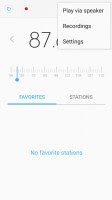
The Galaxy J7 (2016) also has an FM radio built in (something many Galaxy flagships do not). It can record radio broadcasts (though this may be disabled in some regions). There's no RDS though so the app won't show the name of the station.

FM radio
Video player
The video player is the only app that works in pop-up window, a feature dating back to the Galaxy S III.
You also get full subtitle support with advanced features to modify their appearance.

Video player is business as usual

The app lets you play only the audio (if you just want to listen to a music video) and to play the audio via Bluetooth (if you have a BT-enabled speaker handy).
Audio output is good
The Samsung Galaxy J7 (2016) impressed us in the first part of our audio test. The handset showed nicely high volume and excellently clean output for a great showing.
Plugging in our standard headphones caused a moderate amount of damage. The volume dropped from very high to average, and stereo crosstalk rose notably. There was some intermodulation distortion, too, although that wasn’t too. Overall a decent, if unspectacular showing by the mid-ranger.
Here go the results so you can do your comparisons.
| Test | Frequency response | Noise level | Dynamic range | THD | IMD + Noise | Stereo crosstalk |
| Samsung Galaxy J7 (2016) | +0.09, -0.30 | -92.4 | 90.2 | 0.0051 | 0.034 | -92.3 |
| Samsung Galaxy J7 (2016) (headphones) | +0.30, -0.08 | -92.2 | 89.8 | 0.0092 | 0.226 | -54.8 |
| Meizu m3 note | +0.13, -0.00 | -91.9 | 91.9 | 0.0021 | 0.0082 | -91.3 |
| Meizu m3 note (headphones) | +0.02, -0.20 | -90.7 | 91.2 | 0.0028 | 0.050 | -53.4 |
| Lenovo Vibe K5 Plus | +0.02, -0.08 | -93.8 | 92.8 | 0.0037 | 0.034 | -91.3 |
| Lenovo Vibe K5 Plus (headphones) | +0.09, -0.03 | -93.5 | 92.6 | 0.070 | 0.075 | -49.0 |
| Huawei Honor 5X | +0.02, -0.08 | -93.4 | 90.1 | 0.0028 | 0.012 | -93.4 |
| Huawei Honor 5X (headphones) | +0.10, -0.03 | -92.9 | 89.8 | 0.0048 | 0.071 | -78.2 |
| Samsung Galaxy A5 (2016) | +0.02, -0.07 | -94.3 | 92.2 | 0.0065 | 0.010 | -95.0 |
| Samsung Galaxy A5 (2016) (headphones) | +0.42, -0.01 | -93.4 | 87.1 | 0.029 | 0.254 | -53.0 |

Samsung Galaxy J7 (2016) frequency response
You can learn more about the tested parameters and the whole testing process here.
Camera
The Samsung Galaxy J7 (2016) touts a 13MP camera sensor just like its predecessor. However, it's a completely new module with a fast f/1.9 aperture, compared to f/2.2 a year ago. In 4:3 aspect ratio, the camera shoots stills at 4128x3096 pixels.
The J7 (2016) offers Pro mode, but it's nothing like the one on the upper range models. It only gives you White balance, ISO and Exposure compensation. Essentially, the settings most phones have, but in a more accessible arrangement.


The camera UI is overly familiar


The phone also sports the option to quick launch the camera with a double Home button press.
More Modes options include Night mode, Sound & shot, Sports and HDR.
As for the samples themselves are solid for a mid-range smartphone. The photos are rich in detail, a moderate amount of noise, although shadows aren't particularly well developed. Colors are pretty accurate, erring a little on the cold side from time to time.


Samsung Galaxy J7 (2016) camera samples


The HDR samples are excellent, with the J7 (2016) managing to retain extra information in both highlights and shadows without going overboard and producing an overly flat image.


HDR on • HDR off • HDR on • HDR off


And just like the Galaxy J5 (2016), the bigger brother places a special accent on the front-facing camera. It's a 5MP snapper with f/1.9 lens and LED flash for those special party selfies.
Color are excellent and detail is pretty good as well. Dynamic range is pretty limited though as you can see from the sample below.
Selfie camera is good

Finally, we've uploaded 13MP camera samples to our photo quality comparison tool for you to see how the Galaxy J7 (2016) fares against the competition.


Good 1080p videos
The Galaxy J7 (2016) records 1080p @ 30fps. Our video samples were recorded at a bitrate of 17Mbps and with 256Kbps, 48KHz audio.
In terms of quality, colors are nicely shot, while detail is plenty. Contrast is great, too, but the constant focus hunting is rather annoying.
Here is a short 1080p video (8s, 17.9MB) for download.
You can also see how the Galaxy J7 (2016) fares against the competition in our video comparison tool.


Final words
So, Samsung have a new meal on the menu but it's the good old recipe. In fairness, the Galaxy J7 (2016) isn't one of the chef's best, so anyone can understand why it doesn't feature on the specials and why it isn't especially creative with the ingredients.
Yet, it sure has some premium dressing. The Galaxy J7 (2106) has finally joined the club and benefits from the design language introduced by last season's flagships. The result is great build quality and looks that most people would enjoy.

However, unlike the J5 the redesign didn't exhaust the upgrade budget. There was just enough left to bump the RAM and add the Exynos chipset built using the 14nm manufacturing process and boasts excellent power efficiency.
That, and the front-facing camera with LED flash is going to be a valued feature if selfies are an important part of the smartphone experience. There you go, we have the average user profile pretty much sketched. Now, let's have one last close look at the phone.
- Excellent build quality and smart looks
- Display has perfect colors and is always legible; However, 720p is stretched a little too thin on a 5.5" diagonal
- Outrageously good battery life
- Full software package; too much storage is reserved for the system though
- The Samsung Exynos 7870 is nicely optimized, but the GPU performance isn't great
- Decent multimedia package, but lacks Samsung's proprietary music player; an FM radio is on board
- The loudspeaker is okay, but some of the competition is better
- Good audio quality
- In good lighting outdoors, the camera performs excellently, but doesn't offer a lot of detail; great contrast and colors. The front LED flash makes enough of a difference for selfies. HDR mode prioritizes the highlights.
- Video quality at 1080p is good but retains the good colors and contrast from the still camerae
The midrange market is ruthless and Samsung have in no small part contributed to that with a massive portfolio trying to cater to every taste and budget. A successful phone in the lower midrange has to do stuff well and not cost a lot. The Galaxy J7 (2016) is trying to give the best it can for the price. It's faced with fierce competition though that's willing and able to raise the bar and lower the price.
The recently announced Moto G4 Plus is an excellent rival with its 1080p 5.5" IPS LCD screen covered with Gorilla Glass 3. Under the hood, there's a not-so-potent Snapdragon 617 with RAM varying across models and markets. The 16MP f/2.0 camera with dual-LED flash is a promising feature for the price, which is similar to that of the Galaxy J7 (2016). Don't forget the fingerprint sensor, too.
Motorola Moto G4 Plus

The Lenovo Vibe K4 Note is another option you should check out. Same 5.5" display, but a FullHD resolution, plus a fingerprint sensor on the back. While the K4 Note has solid battery life, it's certainly no match for the Galaxy J7 (2016).
Lenovo Vibe K4 Note

Vivo has the V3Max powered by the newer Snapdragon 652. It features 32GB of internal storage and 4GB of RAM as well. The camera experience is also better than the Galaxay J7 (2016), but the phone is hard to find outside India.
vivo V3Max

The Xiaomi Redmi Note 3 can be had for significantly less, and in both versions it has more oomph than the Galaxy J7 (2016). Metal build, FullHD screen resolution and fingerprint recognition are all in its favor.

Xiaomi Redmi Note 3 • Xiaomi Redmi Note 3 (MediaTek)
Finally, the Meizu m3 note is keen to show off its excellent metal build and great battery life, while offering a reasonable package with a few extras, including a fingerprint scanner. It has more of everything: RAM, battery, performance and is an excellent choice for the price. All three of the last alternatives are rather hard to come by in many markets so not really an option for everyone.
Meizu m3 note

Plus, Samsung has the brand recognition, tradition and influence to keep pressure on the competition. A Samsung handset is probably the safer choice when it comes to aftersales and warranty too. Plus, carrier deals make up a big chunk of the revenue from phones like the Galaxy J7.
Politics aside, the Galaxy J7 (2016) is a good looking and well-built smartphone. It covers the basics and throws in some extras like the front-facing camera with LED flash and a well-sized removable battery. Five and half inches of screen diagonal is a nod to users who value size over resolution, and AMOLED seals the deal.
Big screen, selfies, good looks and a solid battery, the Galaxy J7 2016 is good to go. If you want more from your phone, Samsung has the Galaxy A-series. If you want more for your money, be sure to do your homework.

Tidak ada komentar:
Posting Komentar